
BEYOND EARTH / JAMES WEBB SPACE TELESCOPE
The same universe. Different ways of seeing.
One region of space. Two infrared views. What changes is not simply the picture, but the information available to interpret it.
Eagle Nebula · Webb programme 2739
Pillars of Creation
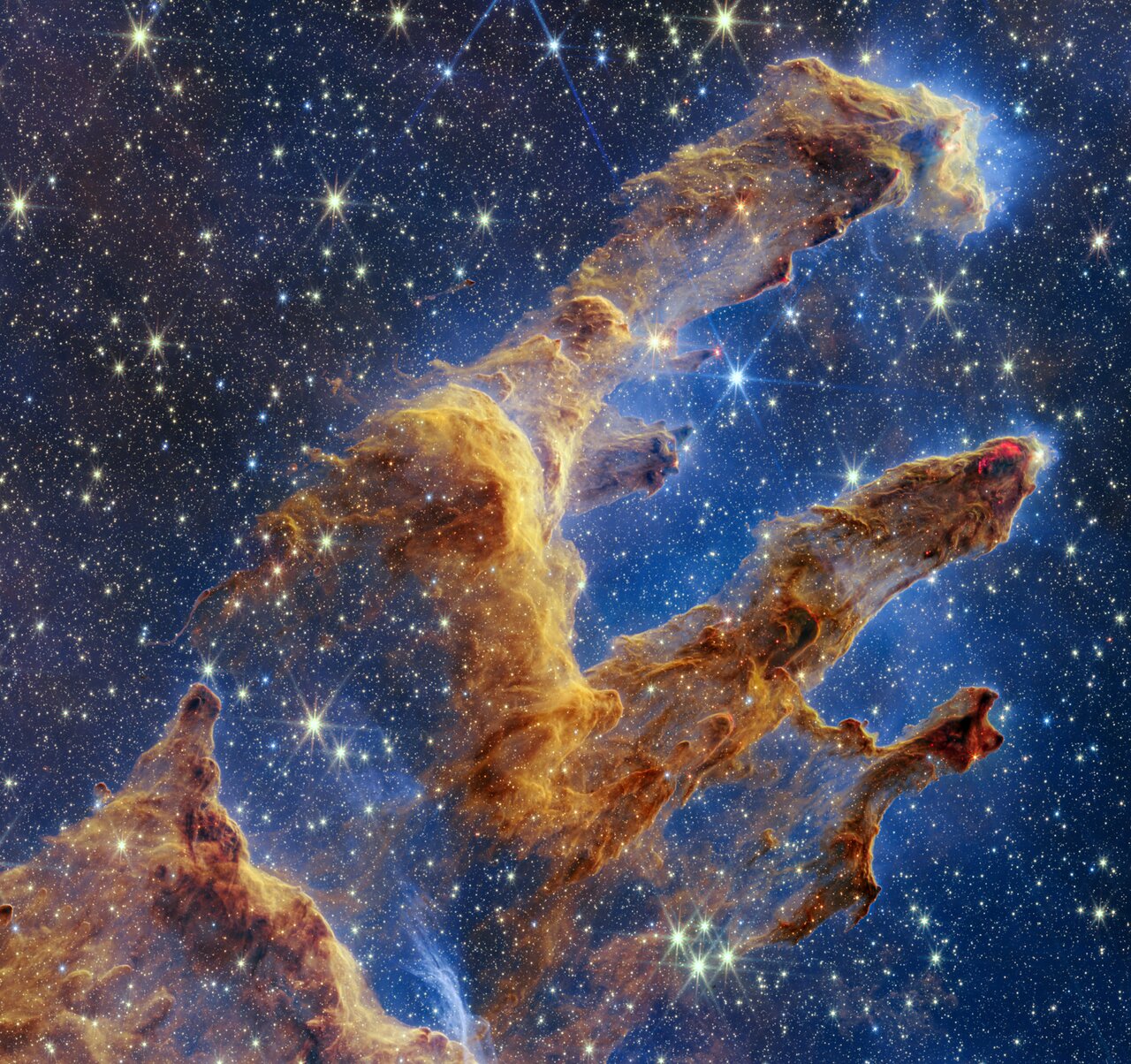
Image unavailable. The explanation and original source remain available below.
NIRCam / Near-infrared
Stars emerge from the dust.
What becomes visible
Many bright points appear between the rust-coloured pillars. Near-infrared light reveals a rich stellar scene alongside the gas and dust.
What the sources support
The published caption identifies young forming stars and describes bright, wavy structures near some pillar edges as ejections from young stars. These are source interpretations, not classifications made by this website.
Original image & caption ↗What this view cannot establish
A bright red point is not, on colour alone, a verified young star. Dust still obscures parts of the scene, and this image does not reveal every object behind the pillars.
Inspect sources & image-making NIRCam
Observation record
- Target
- Pillars of Creation · M16 / Eagle Nebula
- Observing programme
- 2739 (K. Pontoppidan)
- Observation date
- This comparison rendition released
- · weic2218d
- Original instrument image released
- 19 October 2022
- Image processing
- Joseph DePasquale (STScI), Anton Koekemoer (STScI), Alyssa Pagan (STScI)
| Filter | Pivot wavelength (µm) |
|---|---|
| F090W | 0.902 |
| F187N | 1.874 |
| F200W | 1.988 |
| F335M | 3.362 |
| F444W | 4.402 |
| F470N | 4.708 |
Instrument-response reference values from STScI, not measurements of this nebula. Each filter transmits a range of wavelengths.
Assigned colours
F090W → purple; F187N → blue; F200W → cyan; F335M → yellow; F444W → orange; F470N → red.
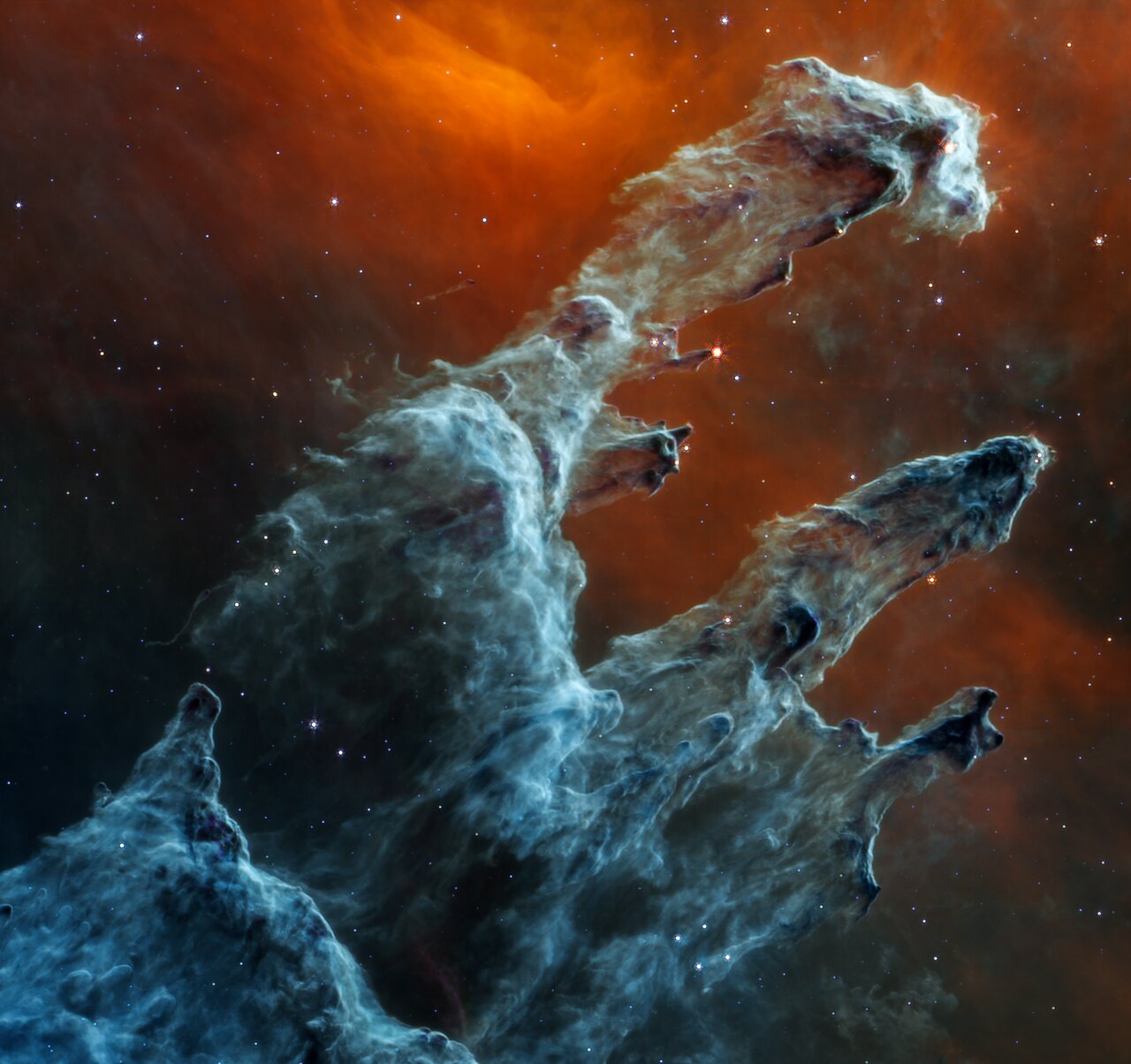
Image unavailable. The explanation and original source remain available below.
MIRI / Mid-infrared
Dust takes the foreground.
What becomes visible
The pillars appear blue-grey, with luminous edges and fewer visible stars. The mid-infrared view emphasises the dust structure.
What the sources support
The published caption associates the dark, dense regions with cold dust and explains why many stars are less prominent at these wavelengths. Their absence from this view does not mean they have disappeared.
Original image & caption ↗What this view cannot establish
The assigned colours are not a temperature scale. Dust mass, composition and temperature cannot be read directly from the display image.
Inspect sources & image-making MIRI
Observation record
- Target
- Pillars of Creation · M16 / Eagle Nebula
- Observing programme
- 2739 (K. Pontoppidan)
- Observation date
- This comparison rendition released
- · weic2218c
- Original instrument image released
- 28 October 2022
- Image processing
- Joseph DePasquale (STScI), Alyssa Pagan (STScI)
| Filter | Pivot wavelength (µm) |
|---|---|
| F770W | 7.639 |
| F1130W | 11.309 |
| F1500W | 15.064 |
Instrument-response reference values from STScI, not measurements of this nebula. Each filter transmits a range of wavelengths.
Assigned colours
F770W → blue; F1130W → green; F1500W → red.
01 / Colour is a translation
A different view, not a later moment
These are infrared observations assembled from separate filtered exposures. Visible colours are assigned to make the data interpretable; they are not what human eyes would see.
NASA records both observations on 14 August 2022. Switching instruments is not a time-lapse: wavelength, sensitivity, resolution and processing affect the appearance. The display images are not calibrated data for measuring brightness, temperature or change.
02 / What would help us understand more?
How much dust is present, and how is it distributed? Published Webb material identifies these as questions for scientific analysis. The images alone do not supply those measurements; calibrated data, suitable models and uncertainty estimates would be needed.
Official comparison ↗ASTRASENSE / Research & Publications
Observation becomes more useful with context.
The instrument, source and earlier interpretation belong alongside an image. Complementary observations can strengthen an explanation or reveal its limits. Keeping that evidence traceable makes revision possible.
This is an AstraSense educational reading of published Webb material. No AstraSense model has processed these images. Cognition, knowledge continuity and World Models remain research directions.
Explore evidence and uncertainty ↗